In the contemporary landscape of early childhood education, digital media and high-impact visual storytelling have emerged as powerful tools for shaping cognitive and social development. This multidimensional "edutainment" ecosystem leverages saturated color palettes, expressive character archetypes, and relatable daily scenarios to build a holistic framework for a child's understanding of the world. By examining themes ranging from basic cognitive sorting to complex emotional intelligence and community responsibility, we can observe how these visual narratives guide a child’s transition into broader social environments.
The Cognitive Blueprint: Visual Logic and Categorization
Long before children master verbal language, they are proficient at decoding visual information through color, shape, and pattern recognition.
Chromatic Education and Set Theory
Strategic color usage is a primary instructional tool used to facilitate categorization and logical grouping.
- Attribute Matching: By presenting brightly colored animals—such as a red tiger, a green lion, or a blue gorilla—alongside soccer balls of identical hues, media teaches children to identify shared attributes across different species. This is a foundational skill for scientific observation and data organization.
- Sequential Order: The arrangement of expressive "talking" eggs and service vehicles in a rainbow spectrum (red, yellow, green, blue, purple) reinforces the concept of linear sequences and predictable order.
- Logical Slots: Visuals featuring colored garage doors or slots that match the colors of specific vehicles help children practice spatial reasoning and attribute-based sorting.
Sensory Bridging and Cause-and-Effect
High-fidelity digital rendering allows children to "feel" textures and mechanical concepts through their eyes.
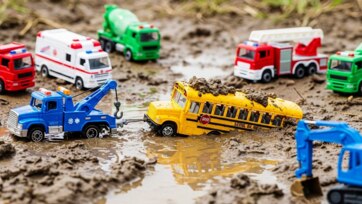
- Tactile Visualization: High-contrast images of toy trucks stuck in thick, viscous mud bridge the gap between digital content and real-world sensory play.
- Mechanical Problem Solving: Seeing a blue tow truck use a cable to pull a yellow school bus out of a mud pit provides a clear lesson in mechanical advantage and community cooperation.
- Physics in Play: Realistic depictions of multiple tractors using chains to pull heavy trucks up a muddy riverbank reinforce concepts of teamwork and the physical force required for heavy-duty tasks.
Social-Emotional Intelligence and Psychological Resilience
One of the most significant roles of modern early media is Social-Emotional Learning (SEL), which provides children with the vocabulary and mirrors needed to understand their internal states.
Identifying and Naming Internal States
Exaggerated facial features help children recognize and validate their own feelings.
- Fear and the Unknown: Visuals of a child reacting with shock to a "ghost" figure in a bathroom or pointing in terror at a large "Spider-Man" themed dinosaur outside a bedroom window help normalize common anxieties.
- Expressing Distress: The use of clear, blue teardrops on a character’s face (as seen on the toddler 'Anna') provides a visual shorthand for sadness, helping children communicate their own distress to caregivers.
- Anticipation and Surprise: Wide-eyed, open-mouthed expressions on characters—whether rushing for a bus or discovering something new—mirror a child’s natural sense of wonder.
Empathy and Communal Bonds
Narratives often focus on supportive social interactions to model healthy relationships.
- Inter-Species Connection: A boy gently interacting with a hen and its fluffy yellow chick models the concept of "gentle hands" and environmental stewardship.
- Gentle Observation: Three green parrots with red beaks sitting quietly on a branch encourage children to look closer at the natural world and appreciate wildlife.
- Shared Journeys: Imagery of friends taking a car ride together through a scenic landscape reinforces the idea that life’s milestones are most rewarding when shared with others.
Community Systems, Hygiene, and Life Skills
As a child's world expands beyond the home, media introduces the systems and routines that govern daily life in a broader community.
Temporal Logic and Punctuality
The scenario of a child rushing to catch a yellow school bus serves as a foundational lesson in societal expectations.
- Time Management: The inclusion of a large, prominent analog clock (showing approximately 7:40 AM) helps children visualize the passage of time and the importance of meeting deadlines.
- Independence: Carrying a backpack toward a vehicle driven by a trusted helper represents a child's growing autonomy as they step into the educational system.
Hygiene as an Interactive Activity
Visual media turns potentially resistant daily tasks like hygiene into playful, positive experiences.
- Visual Motivation: Bold text saying "Brush me" alongside a smiling tooth and a purple toothbrush character transforms a chore into a friendly invitation.
- Conceptualizing Germs: Including a small, grumpy green creature as a symbol of dirt or bacteria helps children visualize why brushing and washing are necessary for health.
The Agricultural and Working World
Farm and construction themes introduce children to the concepts of labor, food production, and cooperation.
- Agricultural Roles: Seeing monkeys driving tractors to transport pails of milk or smiling cows show that every member of a community has a specific task that contributes to the whole.
- The Safety Net of Helpers: Seeing various service vehicles—ambulances, fire trucks, and cement mixers—work together reinforces the idea that the community is supported by a network of professional helpers.
Nature as a Living Classroom
Depictions of natural habitats and animals encourage children to explore the physical world with curiosity and respect.
Biodiversity and Stewardship
By presenting characters in diverse settings, children learn to identify different ecosystems and species.
- Animal Characteristics: Close-ups of roosters with red combs, spotted cows, and goats with horns help children learn the defining physical traits of common animals.
- Gentle Hands: Imagery of a toddler kneeling to feed goats in a meadow or sitting calmly among chickens models respectful behavior toward living beings.
The Value of Experiential Play
Content that features characters playing in the mud or nature validates active learning through sensory experience.
- Normalizing "Messy" Play: Framing a child sitting happily in a mud puddle with a rooster as a moment of joy helps parents and children view the outdoors as a playground for sensory discovery.
- Environmental Empathy: Surrounded by smiling sheep and cattle, the child learns to feel a sense of belonging within the larger natural world.
Conclusion: Synthesizing the Modern Learning Experience
The landscape of early childhood education has been transformed by a carefully architected tapestry of visual media. By using magnetic colors to teach logic, expressive faces to teach empathy, and relatable scenarios to teach responsibility, these digital narratives provide a roadmap for navigating the complexities of the real world.
Whether a child is matching a green lion to a green ball, observing a tow truck rescue a bus, or watching a toddler gently feed a goat, they are building the mental frameworks necessary for success in school and society. These stories turn mundane routines into moments of profound discovery, ensuring that children step out of their homes with the confidence and curiosity needed to explore the wide, wonderful world.