In contemporary early childhood pedagogy, the "visual-first" approach has become a leading method for fostering cognitive, social, and emotional growth. By combining high-contrast digital art, anthropomorphic characters, and carefully crafted social scenarios, modern educational media creates a multi-layered learning environment. This environment not only engages children but also serves as cognitive scaffolding, providing mental templates that help them understand physical mechanics, navigate social interactions, and regulate intense emotions.
The following analysis breaks down the pedagogical themes of visual-first learning, organized according to developmental impact, and emphasizes practical examples that illustrate their effectiveness.
- Cognitive Logic: Categorization, Attributes, and Physics
Visual stimuli are central to early cognitive development, enabling children to decode patterns, relationships, and cause-and-effect dynamics before they develop verbal or numerical literacy.
- Chromatic Logic and Attribute Isolation
Bold, saturated colors are deliberately used to support categorization, sequencing, and set recognition.
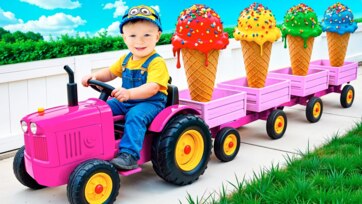
- Sequential Sorting: Visuals such as a child driving a pink tractor pulling trailers filled with red, yellow, green, and blue ice cream cones reinforce linear order, color recognition, and early mathematical concepts.
- Anatomical Visualization: Stylized, glowing skeletons in bright primary colors provide a playful introduction to human anatomy, helping children identify and differentiate body parts while making science approachable.
- Temporal and Identity Association: Graphics showing a white creature holding an orange popsicle that mirrors its own shape teach children to associate objects with identity markers and understand basic temporal concepts, such as the passage of "1 HOUR."
- Pattern Recognition: Repeated visual motifs, like a bouncing ball over alternating colored platforms, support predictive thinking and early problem-solving skills.
- Mechanical Principles and Collaborative Problem-Solving
Play-based mechanical scenarios teach foundational physics, teamwork, and systems thinking.
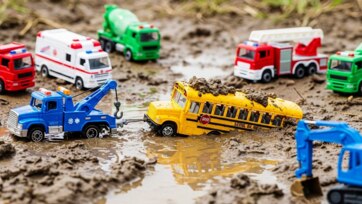
- Complex Recovery Operations: Scenes of two large trucks stuck in a mud pit, being rescued by cranes, tractors, and excavators, illustrate leverage, tension, and the benefits of teamwork in overcoming challenges.
- Interconnected Systems: A baby suspended among interlocking gears demonstrates mechanical interdependence and introduces systems thinking.
- Force and Physics: Tug-of-war visuals with characters pulling ropes tied to giant scissors illustrate opposing forces, tension, and the idea of collective effort.
- Social Order and Authority: "Police babies" rescuing a struggling mermaid or a police dog apprehending a candy thief teach children about rules, roles, and societal structures that maintain safety.
- Social-Emotional Learning (SEL): Mirroring and Resilience
Visual-first media also provides a language for emotions, enabling children to identify, validate, and communicate their inner experiences.
- Validating Fear and Anxiety
Exaggerated expressions and surreal situations act as mirrors for psychological processing.
- Visual Shorthand for Shock: Wide-eyed, gasping characters responding to a giant T-Rex in a living room or a massive bite taken from a strawberry model appropriate reactions to unexpected events.
- Social Horror and Transformation: A peer’s cup-headed transformation in a school hallway helps children explore feelings of exclusion, change, and social fear.
- Processing the Uncanny: Contrasting reactions, such as a startled furry character versus a calm bee, teach children that different individuals may respond differently to the same situation.
- Masking and "Otherness": Imagery of characters with fangs or glowing eyes introduces the concept of hiding emotions or feeling "different," fostering empathy and self-awareness.
- Managing Health, Empathy, and Protection
Simulated social interactions teach care, responsibility, and ethical behavior.
- Caring for the Sick: Scenarios where a character brings lemon water and a thermometer model empathy and practical support during illness.
- Environmental Protection: A child sheltering a lamb from rain encourages responsibility for vulnerable beings.
- Interspecies Care: Bathing a blue, purple-haired creature associates hygiene with joy and nurturing behavior.
- Conflict Resolution: Visuals of characters negotiating toy-sharing or turn-taking teach children how to manage disagreements constructively.
- Life Skills: Personal Responsibility and Community
Visual storytelling transforms mundane routines into engaging learning experiences.
- Hygiene Education and "Health Heroes"
- Visualizing Germs: Large, green, spiky virus monsters help children understand invisible health threats, making hygiene concrete.
- Empowered Defense: Children depicted using toy blasters against germs frame hygiene as active, empowering play rather than a chore.
- Automated Care: Scenes with police dogs navigating car washes reinforce that maintaining tools and personal spaces is routine and rewarding.
- Financial Literacy and Social Roles
Early visual exposure to economic concepts fosters understanding of labor, wealth, and social responsibility.
- Economic Disparity: Contrasting images of children with stacks of cash and "money houses" versus brooms and "cardboard homes" introduce social and economic differences.
- Creative Expression: Surreal imagery, such as stylized faces integrated into fashion items, encourages artistic exploration and design thinking.
- Team-Based Tasks: Visuals of children running marketplaces or small businesses teach collaboration, responsibility, and community participation.
- Biodiversity and Communal Rewards
Nature and communal experiences strengthen environmental awareness and social learning.
- Agricultural Origins: A monkey transporting bananas via tractor teaches resource logistics and farm-to-table concepts.
- Communal Rewards: A police dog serving heart-shaped pizza reinforces cooperation, generosity, and shared joy.
- Animal Interaction: Feeding a giraffe or interacting with a calf cultivates curiosity and respect for biodiversity.
- Environmental Stewardship: Children planting seeds or watering gardens link visual engagement with sustainable behavior and ecological awareness.
- Conclusion: The Integrated Blueprint for Development
The visual landscape of early learning is carefully designed to nurture the "whole child." Saturated colors teach logic, expressive faces teach empathy, collaborative play teaches physics and teamwork, and interactions with nature foster environmental respect.
Each scenario bridges digital and physical learning. Sorting ice cream trailers, protecting animals, or caring for peers equips children with cognitive, social-emotional, and practical skills. Over time, these visual-first experiences cultivate confident, adaptable learners ready to navigate the real world—one frame at a time.