Modern early childhood development is increasingly influenced by a sophisticated "edutainment" ecosystem that leverages high-contrast digital art, relatable anthropomorphic characters, and strategic social modeling. This visual landscape is meticulously designed to provide a structured framework for children to interpret complex concepts ranging from physical mechanics to emotional regulation. By analyzing themes across these varied scenarios, we can observe how visual narratives function as a "digital blueprint" for foundational life skills.
- Cognitive Foundations: Logic, Sorting, and Categorization
Visual stimuli are the primary drivers of early learning, allowing children to decode logical structures such as order, attributes, and sets long before they possess advanced verbal or literacy skills.
- Chromatic Logic and Attribute Isolation
The strategic use of saturated color palettes is a deliberate pedagogical tool used to facilitate categorization.
- Rainbow Sequencing: Content featuring anthropomorphic trucks and expressive eggs arranged in a rainbow spectrum—red, yellow, green, blue, purple—reinforces the mathematical concept of linear progression and predictable order.
- Attribute Matching: Visuals that place specific vehicles next to matching colored garage doors allow children to practice spatial reasoning and attribute sorting, teaching them to isolate color as a primary identifiable trait.
- Mechanical Cause-and-Effect
Toy-based scenarios involving service vehicles provide foundational lessons in physics and problem-solving.
- Mechanical Advantage: A blue tow truck using a cable and hook to rescue a yellow school bus stuck in thick, viscous mud serves as a primary lesson in how tools extend human and mechanical capabilities to overcome environmental resistance.
- Combined Force: Seeing multiple tractors—blue, pink, green, and black—using heavy chains to pull a tanker and cargo truck up a riverbank demonstrates the necessity of collaborative effort for tasks requiring extreme force.
- Environmental Physics: Realistic depictions of mud sticking to tires or vehicles partially submerged in water introduce children to the physical properties of friction, weight, and fluid dynamics in a safe, observational environment.
- Social-Emotional Learning (SEL): The Internal Landscape
A critical component of modern children's media is SEL, which provides children with the visual vocabulary needed to identify and communicate their own complex feelings.
- Mirroring and Naming Emotions
Exaggerated facial expressions act as psychological mirrors, helping children validate and name their internal states.
- Visual Shorthand for Distress: The inclusion of clear, blue teardrops on a character's face—such as the toddler 'Anna'—provides a distinct visual indicator of sadness or fear.
- Externalizing Anxiety: A child pointing in shock at a "Spider-Man" themed T-Rex looking through a bedroom window helps children process and externalize common nighttime anxieties in a controlled narrative setting.
- Processing Surprising Changes: Imagery of one cat looking in shock at another who has partially transformed into a reptilian creature with a purple tongue serves as a visual metaphor for processing unexpected or frightening changes in appearance or behavior.
- Identifying Needs: Visuals of a panda keeper offering a bucket of fresh vegetables to a worried or hungry lion—while an elephant and giraffe look on—demonstrate the developmental ability to recognize and meet the needs of others.
- Conflict Resolution and Social Play
Simulated social interactions between toddlers or animals model the complexities of cooperative play.
- Managing Frustration: A scene where one toddler pushes another on a swing, with both characters displaying intense facial expressions, provides a platform for discussing boundaries, turn-taking, and the emotional friction that can occur during shared play.
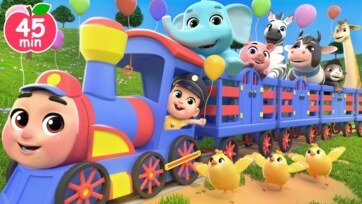
- Inclusion and Companionship: A brightly colored train driven by a young boy and carrying a diverse cargo of animals—elephants, zebras, pigs, giraffes—serves as a metaphor for the intrinsic value of companionship and social inclusion.
- Normalizing Routines and Personal Responsibility
By turning repetitive daily tasks into playful adventures, media reduces a child's resistance to necessary personal care and community expectations.
- Hygiene Education through Personification
Giving inanimate objects a personality transforms personal care from a chore into a social interaction.
- Interactive Motivation: Smiling characters like a "toothbrush" and a "tooth" accompanied by bold text saying "Brush me" transform a hygiene requirement into a friendly invitation.
- Visualizing Health Threats: The use of a small, grumpy green monster as a symbol for germs helps children understand the "why" behind brushing, making the abstract concept of dental health visible and understandable.
- Imaginative Vocational Play
Role-playing adult responsibilities builds confidence and encourages children to explore future possibilities.
- DIY Creativity: A young boy in a pilot's uniform standing next to a large cardboard airplane demonstrates how simple household materials can be the catalyst for global adventure and creative problem-solving.
- Agency and Leadership: Whether a child is shown "driving" a train or "piloting" a plane, these narratives reinforce a sense of agency and leadership over their own developmental journey.
- Resource Management and Agricultural Literacy
Agricultural themes introduce children to the origins of resources and the logistical systems that support modern life.
- Farm-to-Table Concepts: A monkey driving a red tractor to transport a harvest of red bananas introduces the idea of resource transportation and logistical chains.
- Functional Community Roles: Imagery of monkeys driving tractors and managing livestock—cows, horses, goats—demonstrates that every member of a community has a role that contributes to the collective well-being.
- Stewardship of Nature: Positive emotional associations are formed when children see characters happily managing farm environments, fostering an early respect for animal care and environmental maintenance.
- Community Systems and Safety Networks
Children learn to appreciate the "helpers" in their environment by seeing various service sectors work together toward a common goal.
- Service Cooperation: The congregation of a tow truck, ambulance, fire truck, and cement mixer around a rescue scene reinforces the idea that professionals from different sectors collaborate to keep the community safe.
- Zoos and Conservation: Portraying zookeepers and various species interacting peacefully helps children understand the role of human stewardship in protecting biodiversity.
Reflections on Visual Scaffolding
The integrated visual landscape of early learning is more than just entertainment; it is a meticulously designed roadmap for the developing brain. By using saturated colors to teach logic, expressive faces to teach empathy, and mechanical failures to teach resilience, these narratives prepare children for the complexities of the physical world. Each scenario functions as a bridge between the digital screen and the child's physical environment. When a child sees a real school bus, they may recall the importance of a "tow truck" rescue; when they pick up a toothbrush, they see a "friend" rather than a tool. This synergy between visual storytelling and practical life skills ensures that the modern child builds a robust cognitive and emotional foundation, one frame at a time.