A Journey Through Color, Community, and Curiosity
In the foundational years of development, the world is a sprawling classroom without walls, where every visual stimulus and social interaction serves as a critical building block for the future. Modern educational media has harnessed this reality, creating immersive "edutainment" landscapes that blend high-contrast aesthetics with deep psychological lessons. By exploring themes ranging from the frantic energy of a morning school run to the quiet patience required for animal husbandry, these narratives provide a holistic framework for cognitive and emotional growth.
The Vibrancy of Vision: Color as a Cognitive Tool
Color is the first language of the developing mind. Long before children can decode text, they are decoding the spectrum, using hues to categorize, prioritize, and understand their environment.
Primary Anchors and Emotional Resonance
The strategic use of primary colors acts as a visual anchor, helping children navigate complex scenes.
- Radiant Red: Often used for characters of high energy or objects of immediate importance, red triggers attention and alertness.
- Sunny Yellow: Representing optimism and the start of a new day, yellow is frequently worn by protagonists and young animals, signaling a safe, approachable presence.
- Stabilizing Blue: Used for expansive skies or sturdy community vehicles like school buses, blue provides a sense of calm and reliability amidst the chaos of a busy morning.
Logic and Categorization
Interactive visual puzzles, such as matching colorful trucks to corresponding giant eggs, introduce the fundamental principles of mathematical sets and pattern recognition. When a child sees a green truck paired with a green egg, their brain is performing the essential work of logical grouping, a skill that will eventually translate into scientific classification and data organization.
The Social Blueprint: Empathy and Community Roles
Beyond individual logic, early learning must address the "how" of living together. Through character archetypes and social scenarios, children begin to map the complexities of human—and animal—relationships.
Understanding Emotions Through Expression
The use of exaggerated facial features is a deliberate psychological tool to help children identify internal states in themselves and others.
- Surprise and Awe: The wide-eyed, open-mouthed expression of a child discovering a sink full of treats validates their own sense of wonder.
- Distress and Mediation: When two characters clash, the introduction of a third party—such as a police-themed dog—to mediate shows children that conflicts are manageable and that help is available in the community.
- Nurturing and Gentleness: A squirrel looking up at a duckling with a soft, concerned expression teaches the silent language of empathy and the importance of caring for friends who might be feeling small or vulnerable.
Community Systems and Responsibility
Roles in society are introduced through relatable symbols.
- The School Bus: This iconic yellow vehicle represents a child's first step into the public world. The accompanying clock highlights the concept of punctuality and the collective effort required to make society function on time.
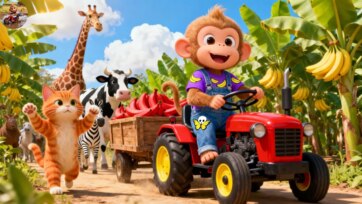
- The Farm System: Seeing monkeys drive tractors or milk cows introduces the idea of labor, food sources, and the symbiotic relationship between humans, animals, and technology. It teaches that everyone, from the driver to the cow, has a vital role in the community "ecosystem".
Sensory Play and the Imagination Laboratory
Imagination is not a distraction from learning; it is the laboratory where children test the limits of their world.
Fantastic Realism
Scenarios that blend the everyday with the impossible—such as treats flowing from a faucet—allow children to practice cognitive flexibility. This "what-if" thinking is the same mental muscle used later in life for creative problem-solving and scientific hypothesis.
Visual Textures
High-quality animation allows children to "feel" with their eyes.
- Gooey/Liquid: Visualizing "slime" or melted chocolate dripping from structures helps children develop a vocabulary for states of matter.
- Tactile Nature: The contrast between the squishiness of mud in a puddle and the soft, downy feathers of a chick provides a sensory roadmap of the physical world.
- Cleanliness Routines: Seeing a monkey react with surprise to a shower turn routines like bathing into a playful, less intimidating experience.
The Great Outdoors: Nature as the Ultimate Teacher
Settings like bamboo forests, wildflower meadows, and muddy barnyards instill an early appreciation for the environment.
Animal Stewardship
Interaction with animals—from feeding goats in a field to sitting in a puddle with a rooster—fosters a sense of stewardship.
- Gentle Hands: When a toddler kneels to offer a hand to a goat, they are practicing the "gentle hands" philosophy, learning that living things require respect and soft touch.
- Species Identification: From the long neck of a giraffe-costumed driver to the horns of a goat and the red comb of a rooster, children learn to identify the diverse characteristics that make each animal unique.
The Value of Curiosity
Whether it is two birds exploring a bamboo forest or a child observing a group of hens, the recurring theme is one of curiosity. These stories encourage children to look closer at their own world, to ask questions about how things grow, and to find beauty in the dirt and the sky alike.
Conclusion: Preparing for the Journey Ahead
The journey of early childhood is a transition from the self to the world. By wrapping essential lessons in the bright colors of a road trip, the excitement of a school bus run, and the joy of a muddy afternoon on the farm, we provide children with a toolkit for life.
Education, at its most effective, is a blend of logic and love. It is the realization that while we must learn to sort our "eggs" and watch the clock, we must also learn to smile at a friend and care for the creatures around us. As the sun sets on another day of play and learning, the child is left not just with facts, but with a sense of wonder that will drive their discovery for years to come.