In contemporary early childhood pedagogy, the "visual-first" approach has emerged as a dominant force in cognitive and social-emotional development. By leveraging high-contrast digital art, relatable anthropomorphic characters, and strategic social modeling, modern educational media creates a multi-layered learning environment designed to nurture the "whole child." This extensive visual ecosystem functions as a form of cognitive scaffolding, providing children with the mental blueprints necessary to interpret complex physical mechanics, navigate social friction, and regulate intense internal emotions.
The following analysis expands on these pedagogical themes, emphasizing practical examples, extended scenarios, and deeper developmental connections.
- Cognitive Logic: Categorization, Attributes, and Physics
Visual stimuli serve as the primary engines of early learning, allowing children to decode logical structures such as order, attribute matching, and cause-and-effect long before they achieve verbal or mathematical literacy.
- Chromatic Logic and Attribute Isolation
The deliberate use of saturated, bold color palettes facilitates categorization and foundational set theory.
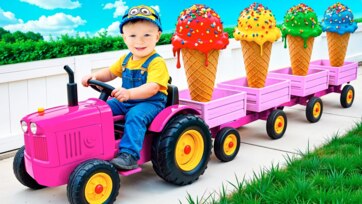
- Sequential Sorting: Large-scale visuals, such as a child driving a pink tractor pulling trailers of red, yellow, green, and blue ice cream cones, reinforce color recognition alongside the concept of linear sets and sequential order. Children can later transfer this understanding to classroom activities like arranging blocks by size or color.
- Anatomical Visualization: Stylized, glowing skeletons in bright primary colors provide a playful introduction to human anatomy, helping children distinguish between structural forms while connecting visuals to the real human body.
- Temporal and Identity Association: High-contrast graphics, such as a white creature holding an orange popsicle that mirrors its shape, help children associate objects with identity markers and understand duration through "1 Hour" timestamps. This encourages early comprehension of sequencing events and basic time concepts.
- Mechanical Principles and Collaborative Problem-Solving
Hands-on play depicted visually fosters early understanding of physics and teamwork.
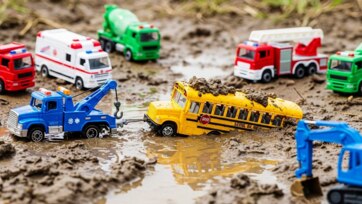
- Complex Recovery Operations: A scene where two large trucks are stuck in a mud pit, pulled out by a yellow crane, a red tractor, and various excavators, illustrates leverage, tension, and cooperative problem-solving. Children intuitively understand that some challenges require multiple agents working together.
- Interconnected Systems: Visuals of a baby suspended in a series of interlocking gears introduce the idea that machines rely on coordinated parts, laying early groundwork for engineering concepts.
- Social Order and Authority: Scenes like "police babies" carrying a struggling mermaid or a police dog chasing a candy thief demonstrate cause-and-effect reasoning and basic societal rules, emphasizing community roles and fairness from an early age.
- Social-Emotional Learning (SEL): Mirroring and Resilience
Modern children’s media provides a visual vocabulary for internal states, teaching children to identify, validate, and communicate complex emotions.
- Validating Fear and Anxiety
Exaggerated facial expressions and surreal scenarios serve as psychological mirrors.
- Visual Shorthand for Shock: Wide-eyed, gasping expressions, in response to a giant T-Rex or massive bee, help children visually process unexpected or overwhelming changes.
- Social Horror and Transformation: Peers experiencing a cup-headed transformation provide a framework to discuss feelings of exclusion, social change, or anxiety over differences.
- Masking and "Otherness": Characters with fangs or glowing eyes can be used to explore the masking of emotions or the feeling of being “different,” encouraging empathy and self-awareness.
- Managing Health, Empathy, and Protection
Simulated social scenarios help children understand care, responsibility, and ethical behavior.
- Caring for the Sick: A character delivering lemon water and a thermometer teaches practical empathy and the recognition of illness management tools.
- Environmental Protection: A child shielding a lamb from rain demonstrates responsibility for vulnerable beings and nurtures a protective instinct toward animals and the environment.
- Interspecies Care: Bathing a fantastical creature reinforces hygiene as a joyful, nurturing act, linking responsibility with positive emotion.
- Life Skills: Personal Responsibility and Community
By transforming daily tasks and community roles into playful adventures, visual media reduces resistance to societal expectations.
- Hygiene Education and "Health Heroes"
Abstract health concepts become concrete through engaging visuals.
- Visualizing Germs: Large, green, spiky "virus" monsters make invisible pathogens tangible, teaching why hygiene matters.
- Empowered Defense: Toy blasters fighting germs frame hand-washing as an active defense rather than a chore.
- Automated Care: Police dogs navigating car washes with soap and colorful brushes reinforce routine cleaning as a necessary maintenance skill.
- Financial Literacy and Social Roles
Visual representations introduce concepts of wealth, labor, and social responsibility.
- Symbolism of Economic Disparity: Children with stacks of cash versus those with brooms or cardboard homes illustrate early lessons in inequality, reward, and aspiration.
- Creative Expression: Surrealist imagery, such as stylized female faces integrated into fashion items, encourages artistic exploration and understanding of personal expression.
- Biodiversity and Communal Rewards
Visual media introduces children to the origins of resources, animal life, and shared societal joy.
- Agricultural Origins: A monkey transporting bananas via tractor highlights "farm-to-table" logistics, connecting visuals to everyday food systems.
- Communal Rewards: Sharing heart-shaped pizza with peers underscores collaboration, generosity, and social joy.
- Animal Interaction: Feeding a giraffe or holding a calf’s tail provides early tactile connections to the natural world, fostering respect for biodiversity and curiosity about living creatures.
- Conclusion: The Integrated Blueprint for Development
The visual landscape of early learning is a carefully constructed tapestry, intentionally targeting the "whole child." Saturated colors teach logic, expressive faces teach empathy, and collaborative play teaches physics, teamwork, and social responsibility.
Each visual scenario bridges the digital screen and the physical environment. When children sort colorful "ice cream" trailers or learn to shield a lamb from rain, they internalize lessons in cognition, social-emotional understanding, and practical life skills. Over time, this foundation fosters confident, adaptable learners capable of navigating complex real-world challenges—one frame at a time.